Worldbuilding for Tabletop RPGs: 7 Techniques to Make Your Setting Unforgettable
A memorable setting feels alive at the table, not impressive on paper. Seven techniques for building a world your players actually want to explore.
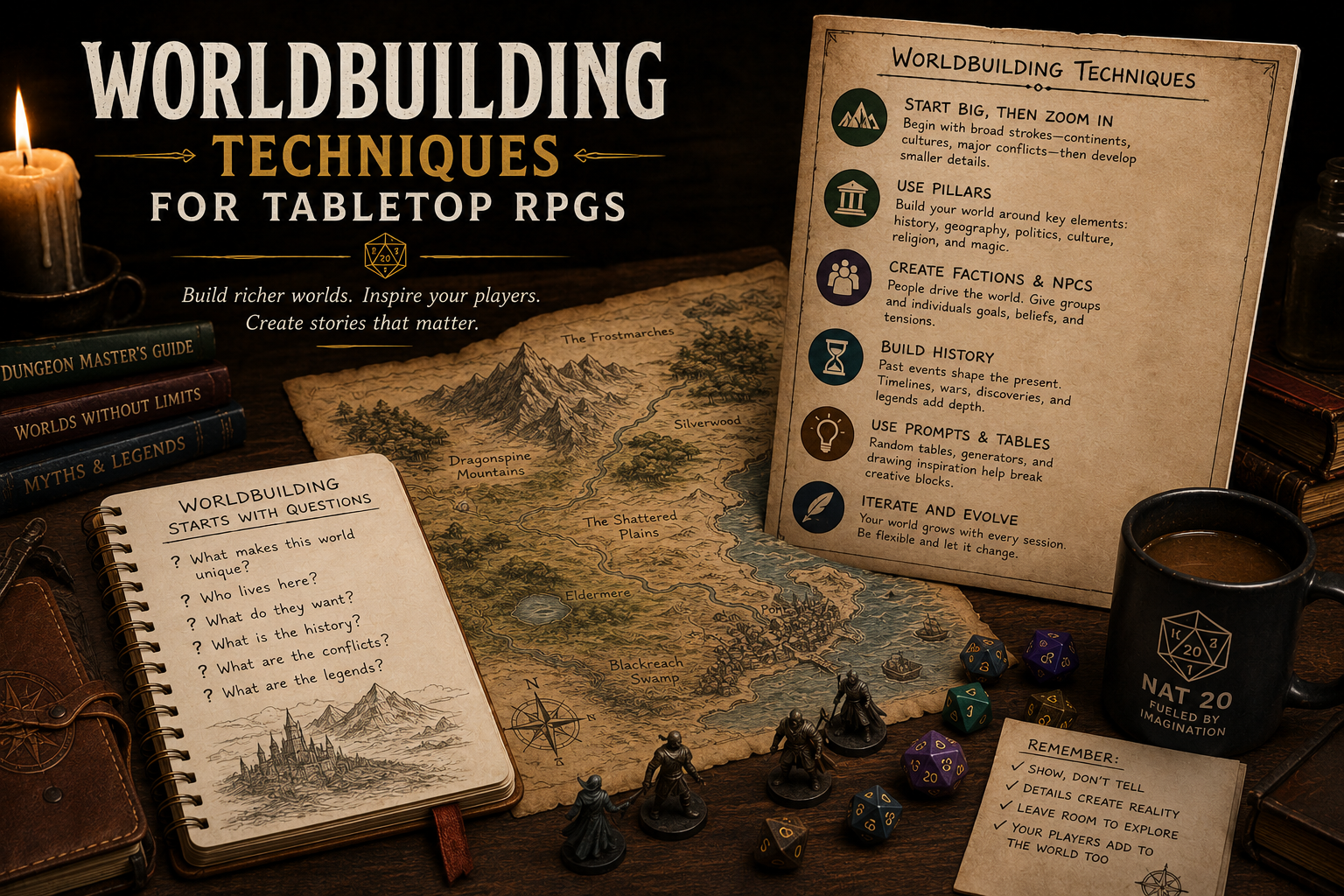
A memorable setting isn't the one with the most lore — it's the one that feels alive at the table. Players don't remember your 40-page history of the elven dynasties; they remember the blind fishmonger who always knows the harbor gossip. These seven worldbuilding techniques focus on exactly that: creating a world that's vivid to play in, not just impressive to read.
1. Build outward from the party
Start with the tavern, not the cosmology. Detail the town the party begins in — a few NPCs, a local problem, a rumor or two — and expand only when the story reaches farther. This top-of-the-funnel approach means every hour of prep goes toward something players will actually touch this month.
2. Give every place a problem
A location without tension is scenery. A location with a problem is an adventure hook. The mining town's vein has run dry. The temple's oracle has gone silent. The river that feeds three villages is being dammed upstream. Attach one unresolved problem to each place and your map becomes a web of quests.
3. Make factions want things
The engine of a living world is factions with goals that collide. The merchant guild wants open borders; the crown wants tariffs; the smugglers want both to fail. When the party pulls a thread, these groups react — and the world seems to move on its own. Track three or four factions, each with a goal and a next move, and you'll never run out of plot.
4. Anchor the world with sensory details
Immersion is built from small, concrete specifics: the smell of tanneries near the river gate, the way the city's coins are stamped with a two-faced king, the festival where everyone wears masks of the dead. Three vivid details do more than three paragraphs of exposition. Collect a handful for each major location and drop them in as the party arrives.
5. Let history show its scars
Deep worlds feel deep because the past is visible. A war-cracked statue in the town square, a calendar that still counts years from a plague, a noble house everyone quietly distrusts — these hint at history without a lecture. Players will invent the backstory themselves, and they'll be delighted when the truth turns out to be even stranger.
6. Keep a consistent bible
Contradictions break immersion faster than anything: the duke who was named Aldric last month is suddenly Aldous, the city three days away is now a week's ride. Keep a single reference for names, places, and facts. In Nat20 you can build this as a custom ruleset— adding your world's locations, NPCs, and organizations as entities you can link straight from your campaign episodes, so the canon stays consistent as the world grows.
7. Leave deliberate blank spaces
The most powerful worldbuilding tool is restraint. Leave regions unmapped, questions unanswered, and gods whose true nature is disputed. Blank space is an invitation — for players to fill with their backstories, and for you to improvise without contradicting yourself. A world that's 80% defined and 20% mystery beats one that's exhaustively documented and airless.
Bringing it to the table
Worldbuilding isn't a phase you finish before the campaign — it's a habit you keep throughout. After each session, spend five minutes adding the NPC the party latched onto or the rumor they chased, and your setting deepens naturally in the exact directions your players care about. Steal shamelessly from real history and other tables, too: browse community rulesets for locations and factions you can adapt into your own world.