Pathfinder 2e Encounter Building: XP Budget and Examples
Build Pathfinder 2e encounters with the GM Core XP budget: five threats, party size, creature level vs party level, and a worked example for every threat.
Pathfinder Second Edition gives game masters something D&D never quite did: an encounter budget that works. Pick how dangerous the fight should be, read a number off a table, and spend it on creatures whose cost depends only on how their level compares with the party's. Follow it and a Moderate fight plays like a Moderate fight, at level 1 or level 15. Ignore it, especially by putting a creature four levels above the party in front of them, and the dice stop mattering very quickly.
This guide goes through the whole method from Pathfinder GM Core: the five threat levels and their XP budgets, how to adjust for three, five or six players, what each creature level costs and what role it plays, and the quick templates GM Core suggests. Then it shows why it works, with the numbers of a level-5 party fighting creatures from level 1 to level 9, builds one encounter for every threat level plus one for a party of five and one for a party of three, and ends with what the budget leaves out and how to run the fight in Nat20.
The short version
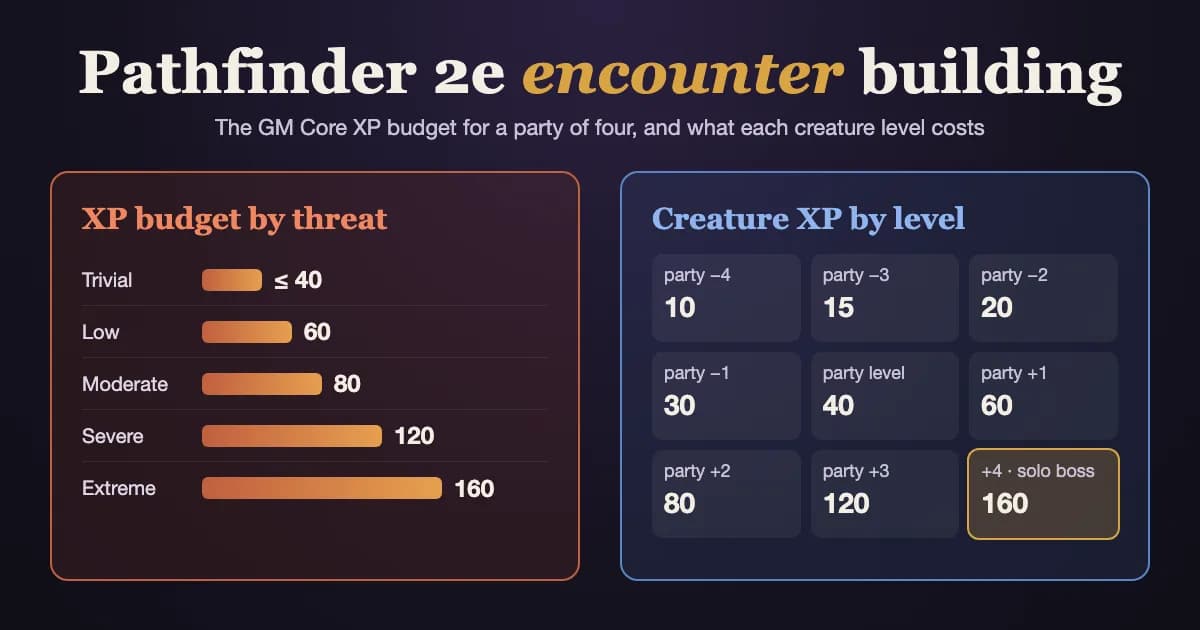
- Pick a threat: Trivial, Low, Moderate, Severe or Extreme. For four characters the budgets are 40 XP or less, 60, 80, 120 and 160 XP.
- Adjust for party size: add or remove 20 XP per character for Low and Moderate, 30 for Severe, 40 for Extreme.
- Spend it on creatures: a creature of the party's level costs 40 XP; each level below or above changes the price, from 10 XP at four levels below to 160 XP at four above.
- Mind the level gap: a level is worth about +1 to every number, so four levels is a different weight class. At party level 5, the fighter's first Strike crits a level-1 creature 55% of the time and a level-9 creature only 5%.
- Then look past the budget: count actions, think about the terrain, and remember that a single boss gets 3 actions a round against the party's 12.
Which rules this guide uses
The encounter rules come from Pathfinder GM Core, the remastered game master's book Paizo published under the open ORC License, and the example fighter from Pathfinder Player Core; both were read on Archives of Nethys, the official online rules reference, on . This guide uses the Remaster's numbers and names (Off-Guard instead of flat-footed, Reactive Strike instead of Attack of Opportunity), as Nat20's Pathfinder 2e ruleset does.
No published monster is used. The creatures in this guide are generic: "a level-7 creature" has the AC, Hit Points and Strike numbers GM Core's creature-building tables give a typical creature of that level. That is deliberate. Those tables are GM Core's benchmarks for building a creature of a given level, so they show what a level difference means without depending on one stat block, and a creature you pick from a bestiary will usually sit near them.
Step 1: pick the threat
GM Core sorts combat encounters into five threats. A Trivial fight cannot really be lost; it is a warm-up, or a chance to show how far the characters have come. A Low fight costs some resources but rarely puts anyone in danger. Moderate is the workhorse: a real challenge that needs sound tactics, after which the party can usually carry on without resting. Severe is the hardest fight most parties have a good chance to win, the right size for a boss at the end of an adventure, and a character could die in it. Extreme is an even match: GM Core suggests it only when you are willing to see the whole party die, such as the finale of a campaign with a rested group going all out.
Each threat has an XP budget, written for a party of four. You spend it on creatures (and hazards) until the total is close to the budget; GM Core is clear that encounters rarely match it exactly, but they should come close.
| Threat | XP budget | Per character above or below four | What it means |
|---|---|---|---|
| Trivial | 40 or less | 10 or less | No real chance of losing; a warm-up or a show of how strong the party is |
| Low | 60 | 20 | Some resources spent; the party is rarely in danger |
| Moderate | 80 | 20 | A serious challenge that takes sound tactics and some resources |
| Severe | 120 | 30 | The hardest fight most parties can expect to win; a character could die |
| Extreme | 160 | 40 | An even match; the whole party could die |
Most adventures mix the threats. GM Core warns that a string of Moderate fights feels flat: use Low and even Trivial fights to let the characters shine, Severe ones for the enemies that matter, and Extreme sparingly. One more thing to know before you start: the XP the party earns is the creatures' XP, the same total you spent, and a Trivial encounter normally earns none.
Step 2: adjust for the size of your party
The budget assumes four characters. For every character beyond the fourth, add the threat's character adjustment; for every missing character, take it away. A Moderate fight for five characters is 80 + 20 = 100 XP; a Severe fight for three is 120 − 30 = 90 XP.
| Threat | 3 characters | 4 characters | 5 characters | 6 characters |
|---|---|---|---|---|
| Trivial | 30 or less | 40 or less | 50 or less | 60 or less |
| Low | 40 | 60 | 80 | 100 |
| Moderate | 60 | 80 | 100 | 120 |
| Severe | 90 | 120 | 150 | 180 |
| Extreme | 120 | 160 | 200 | 240 |
Two rules come with the adjustment. Spend the extra XP on more enemies rather than a tougher one, and take XP away by removing enemies rather than weakening the main one; fights tend to work best when the number of enemies is close to the number of characters. And the XP the party earns does not change: a Moderate fight is worth 80 XP to each character whether you built it for three or six.
Characters of different levels. GM Core recommends keeping everyone at the same XP. If you do not, pick the level that best represents the group. When one character is two or more levels ahead of the rest, use the lower level and count that character as one extra character for every 2 levels of difference. Three characters at level 5 and one at level 7 therefore build like 5 characters at level 5: a Moderate budget of 100 XP.
Step 3: spend the budget on creatures
A creature's price depends only on its level relative to the party level. GM Core keeps encounters within four levels either side, and gives each step a suggested role: a creature four levels below the party is a lackey for an easy fight, one at the party's level is a standard foe, and one four levels above is a solo boss for an Extreme fight. The table shows the prices, with the actual creature levels for a level-5 party, which is the party every example below uses.
| Creature level | For a level-5 party | Creature XP | Suggested role | Simple hazard | Complex hazard |
|---|---|---|---|---|---|
| Party level −4 | Level 1 | 10 | Low-threat lackey | 2 | 10 |
| Party level −3 | Level 2 | 15 | Low- or moderate-threat lackey | 3 | 15 |
| Party level −2 | Level 3 | 20 | Any lackey or standard creature | 4 | 20 |
| Party level −1 | Level 4 | 30 | Any standard creature | 6 | 30 |
| Party level | Level 5 | 40 | Any standard creature or low-threat boss | 8 | 40 |
| Party level +1 | Level 6 | 60 | Low- or moderate-threat boss | 12 | 60 |
| Party level +2 | Level 7 | 80 | Moderate- or severe-threat boss | 16 | 80 |
| Party level +3 | Level 8 | 120 | Severe- or extreme-threat boss | 24 | 120 |
| Party level +4 | Level 9 | 160 | Extreme-threat solo boss | 32 | 160 |
Hazards cost XP too. A complex hazard, one that acts in initiative like a creature, costs the same as a creature of its level. A simple hazard, a trap that triggers once, costs a fifth of that: a simple hazard of the party's level is worth 8 XP. A hazard is a good way to spend the last few XP of a budget, or to make a Low fight interesting without adding another creature.
The quick templates
If you want a shape rather than a calculation, GM Core lists seven ready-made groups you can fill with creatures of the right levels. Each one adds up to a threat budget for four characters, so all you choose is the creatures.
| Group | Creatures | XP | At party level 5 |
|---|---|---|---|
| Boss and lackeys | 1 × party level +2 + 4 × party level −4 | 120 | 1 × level 7 + 4 × level 1 |
| Boss and lieutenant | 1 × party level +2 + 1 × party level | 120 | 1 × level 7 + 1 × level 5 |
| Elite enemies | 3 × party level | 120 | 3 × level 5 |
| Lieutenant and lackeys | 1 × party level + 4 × party level −4 | 80 | 1 × level 5 + 4 × level 1 |
| Mated pair | 2 × party level | 80 | 2 × level 5 |
| Troop | 1 × party level + 2 × party level −2 | 80 | 1 × level 5 + 2 × level 3 |
| Mook squad | 6 × party level −4 | 60 | 6 × level 1 |
Creature level vs party level: why +4 is a boss and −4 is fodder
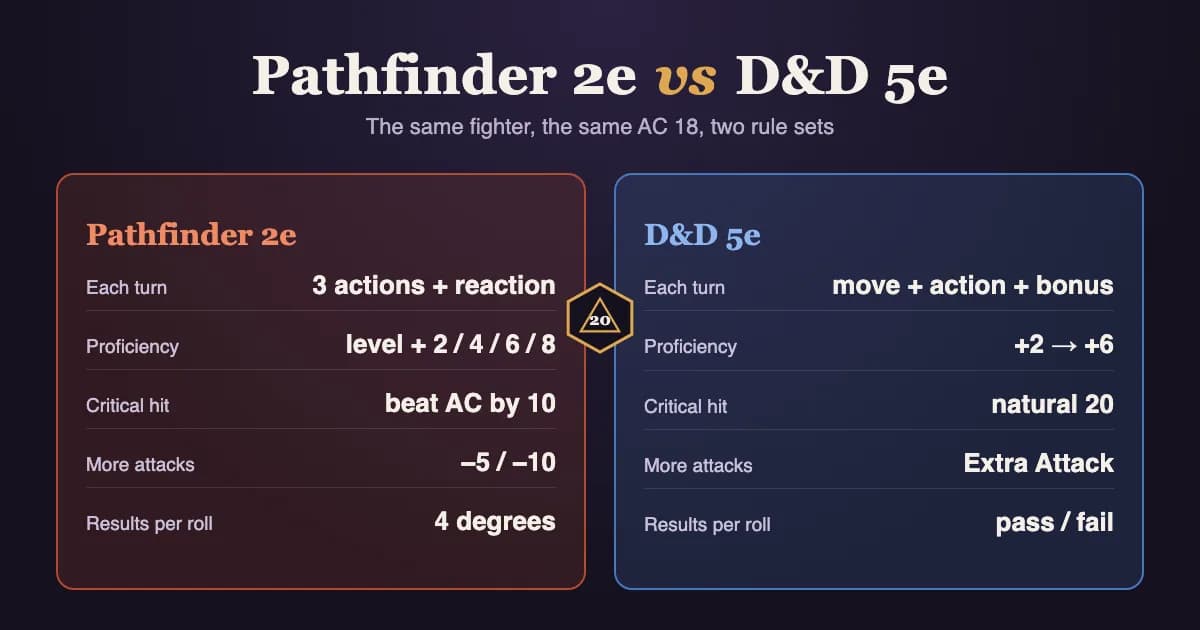
The budget only works because Pathfinder's numbers scale with level so evenly. Every check adds the character's level (see Pathfinder 2e vs D&D 5e for how proficiency works), and a creature's AC, saves, attack bonus, damage and Hit Points all rise with its level at the same pace. One level of difference is about 1 point on every roll, in both directions. And Pathfinder has four degrees of success: beat a DC by 10 and you critically succeed, which for a Strike means double damage. So a few points of difference do not just change whether you hit; they change how often you crit, and how often you are crit.
To see it, take the party's fighter: a level-5 fighter who is a master with the longsword, Strength +4, attacking at +15 for 1d8 + 4 (8.5 damage on average, double on a crit) and making three Strikes a turn with the multiple attack penalty. No magic weapon: a potency or striking rune would raise every number in the fighter's rows. Against them, put a creature of each level from 1 to 9 with GM Core's moderate AC and moderate Hit Points.
| Creature | Moderate AC | First Strike: hits / crits | Three-Strike turn, expected damage | Moderate HP | Fighter's turns to deal that HP |
|---|---|---|---|---|---|
| Level 1 (−4) | 15 | 95% / 55% | 27.2 | 19–21 | 0.7–0.8 |
| Level 2 (−3) | 17 | 95% / 45% | 23.8 | 28–32 | 1.2–1.3 |
| Level 3 (−2) | 18 | 90% / 40% | 21.675 | 42–48 | 1.9–2.2 |
| Level 4 (−1) | 20 | 80% / 30% | 17.425 | 57–63 | 3.3–3.6 |
| Level 5 (+0) | 21 | 75% / 25% | 15.725 | 72–78 | 4.6–5.0 |
| Level 6 (+1) | 23 | 65% / 15% | 12.325 | 91–99 | 7.4–8.0 |
| Level 7 (+2) | 24 | 60% / 10% | 10.625 | 111–119 | 10.4–11.2 |
| Level 8 (+3) | 26 | 50% / 5% | 7.65 | 131–139 | 17.1–18.2 |
| Level 9 (+4) | 27 | 45% / 5% | 6.8 | 151–159 | 22.2–23.4 |
Against a level-1 creature the fighter's first Strike hits 95% of the time and crits 55%; the three-Strike turn averages 27.2 damage, more than the creature's 19–21 Hit Points. The fighter alone drops it in 0.7–0.8 turns on average. Against a level-9 creature the same Strike hits 45% and crits 5% (only on a natural 20), the turn averages 6.8, and dealing its 151–159 Hit Points takes 22.2–23.4 of the fighter's turns.
Now turn it around. GM Core says a creature's high AC is comparable to a PC fighter's, so give the party fighter AC 22, the high AC for level 5, and let creatures of each level attack it with GM Core's high Strike bonus and high damage, the numbers for a creature built to fight in melee.
| Creature | Strike bonus | First Strike: hits / crits | Damage per hit | Two Strikes, expected damage |
|---|---|---|---|---|
| Level 1 (−4) | +9 | 40% / 5% | 1d6+3 (6) | 3.9 |
| Level 2 (−3) | +11 | 50% / 5% | 1d10+4 (9) | 7.65 |
| Level 3 (−2) | +12 | 55% / 5% | 1d10+6 (12) | 11.4 |
| Level 4 (−1) | +14 | 65% / 15% | 2d8+5 (14) | 17.5 |
| Level 5 (+0) | +15 | 70% / 20% | 2d8+7 (16) | 22.4 |
| Level 6 (+1) | +17 | 80% / 30% | 2d8+9 (18) | 30.6 |
| Level 7 (+2) | +18 | 85% / 35% | 2d10+9 (20) | 38 |
| Level 8 (+3) | +20 | 95% / 45% | 2d10+11 (22) | 50.6 |
| Level 9 (+4) | +21 | 95% / 50% | 2d10+13 (24) | 58.8 |
The level-1 creature hits the fighter 40% of the time and crits only on a natural 20. The level-9 creature misses only on a natural 1 and crits 50% of the time with its first Strike. That is what the roles in the XP table mean. A party-level −4 creature cannot threaten anyone on its own; it matters only in numbers, and it dies to a single turn. A party-level +4 creature is an even fight for the whole party, so it should be the only creature in the encounter: its XP is the entire Extreme budget. Between those extremes each level moves every roll by one or two points, 5 to 10 percentage points, and the XP price doubles every two levels.
Worked examples: one encounter for every threat
The examples use a level-5 party of four (a fighter, a rogue, a cleric and a wizard) unless the heading says otherwise. The table at the end of this section adds each one up: the XP against the budget, the actions each side gets per round, the enemies' total Hit Points, and how much damage the enemies' Strikes would deal per round to an AC 22 character if every creature spent two of its actions Striking. That last number is not a prediction of the fight (creatures move, cast and miss turns); it is a way to compare how hard each encounter hits.
Trivial: two lackeys
Two level-3 creatures, party level −2: 20 + 20 = 40 XP, the top of the Trivial range. Guards at a gate, a pair of wolves on the road. The party should win without spending anything that matters; if a player uses their best spell here, that is information about how they read the fight, not a balance problem.
Low: one creature above the party
One level-6 creature, party level +1: 60 XP, exactly the Low budget. It is tougher than any single character, with 91–99 Hit Points, but four characters get 12 actions a round to its 3. A variant with a hazard spends the same 60 XP as one level-5 creature (40 XP) and a level-3 complex hazard (20 XP), such as a collapsing ceiling the party has to deal with while it fights.
Moderate: a troop
GM Core's Troop: one creature of the party's level and two of party level −2, a level-5 leader and two level-3 followers: 40 + 20 + 20 = 80 XP. Three enemies with 9 actions a round against the party's 12, 156–174 Hit Points between them, and 45.2 expected damage a round if they all Strike twice. This is the standard fight of a Pathfinder adventure.
Severe: boss and lackeys
One level-7 boss (party level +2, 80 XP) and four level-1 lackeys (party level −4, 10 XP each): 120 XP, the Severe budget. The lackeys are there for the action economy. Together the enemies get 15 actions a round, more than the party's 12, and their Strikes add up to 53.6 expected damage a round. Each lackey dies to one good hit, so the party is rewarded for clearing them quickly and punished for ignoring them.
Extreme: a solo boss
One level-9 creature, party level +4: 160 XP, the whole Extreme budget. Only 3 actions a round, but every one of them counts: two of its Strikes average 58.8 damage against AC 22, close to the fighter's 68 Hit Points. The section on what the budget misses looks at this fight in detail.
A party of five: the troop again
With five characters the Moderate budget is 100 XP. Following GM Core's advice, the extra 20 XP buys one more follower rather than a tougher leader: one level-5 creature and three level-3 creatures, 40 + 3 × 20 = 100 XP. Four enemies for five characters, 12 actions a round against 15.
A party of three: a smaller Severe
With three characters the Severe budget is 90 XP. Keep the level-7 boss (80 XP) and spend the remaining 10 XP on one level-1 lackey instead of four. The fight keeps its centrepiece, and the enemies get 6 actions a round against the party's 9. A level-6 boss with three lackeys would also add up to 90 XP, but it weakens the main enemy, which is exactly what GM Core advises against: with fewer characters, take enemies away instead.
| Encounter | Party | Opponents | XP / budget | Actions a round: enemies / party | Enemy HP | Expected Strike damage a round at AC 22 |
|---|---|---|---|---|---|---|
| Trivial: two lackeys | 4 characters | 2 × level-3 creature | 40 / 40 | 6 / 12 | 84–96 | 22.8 |
| Low: one boss | 4 characters | 1 × level-6 creature | 60 / 60 | 3 / 12 | 91–99 | 30.6 |
| Low: a creature and a hazard | 4 characters | 1 × level-5 creature + 1 × level-3 complex hazard | 60 / 60 | 3 / 12 | 72–78 | 22.4 |
| Moderate: a troop | 4 characters | 1 × level-5 creature + 2 × level-3 creature | 80 / 80 | 9 / 12 | 156–174 | 45.2 |
| Severe: boss and lackeys | 4 characters | 1 × level-7 creature + 4 × level-1 creature | 120 / 120 | 15 / 12 | 187–203 | 53.6 |
| Extreme: a solo boss | 4 characters | 1 × level-9 creature | 160 / 160 | 3 / 12 | 151–159 | 58.8 |
| Moderate, party of five | 5 characters | 1 × level-5 creature + 3 × level-3 creature | 100 / 100 | 12 / 15 | 198–222 | 56.6 |
| Severe, party of three | 3 characters | 1 × level-7 creature + 1 × level-1 creature | 90 / 90 | 6 / 9 | 130–140 | 41.9 |
Read down the last column and the threat levels make sense in hit points: the Trivial pair's Strikes average 22.8 a round, the troop's 45.2, the boss and lackeys 53.6, and the solo boss 58.8 from just two Strikes. The party of five's Moderate fight hits harder than the party of four's (56.6), as it should, because there is one more character to absorb it.
What the XP budget does not tell you
Two encounters with the same XP can play very differently. The budget is built for an average fight on an average battlefield; these are the things to check after the arithmetic.
Three actions, and what a solo boss does with them
Every creature in Pathfinder gets three actions a turn, and a Strike costs one, but each Strike after the first takes the multiple attack penalty: −5 for the second, −10 for the third (−4 and −8 with an agile weapon). Here is one round of the Extreme fight, the level-9 creature Striking the fighter three times and the fighter Striking it three times.
| Attack | Bonus | Hits | Crits | Expected damage |
|---|---|---|---|---|
| Level-9 creature: Strike 1 (AC 22) | +21 | 95% | 50% | 34.8 |
| Level-9 creature: Strike 2 (AC 22) | +16 | 75% | 25% | 24 |
| Level-9 creature: Strike 3 (AC 22) | +11 | 50% | 5% | 13.2 |
| The creature’s turn | 72 | |||
| Fighter: Strike 1 (AC 27) | +15 | 45% | 5% | 4.25 |
| Fighter: Strike 2 (AC 27) | +10 | 20% | 5% | 2.125 |
| Fighter: Strike 3 (AC 27) | +5 | 5% | 0% | 0.425 |
| The fighter’s turn | 6.8 | |||
On average the creature's turn deals 72 damage, more than the fighter's 68 Hit Points, while the fighter's turn deals 6.8. That is the reason a +4 creature is a solo boss and never one boss among several: the party wins this fight by out-acting it, 12 actions to 3, spending actions on things other than Striking. Two examples. A wizard's Fear that the boss fails its Will save against leaves it Frightened 2, a −2 status penalty to its checks, and its turn drops to 61.2 expected damage. Two characters flanking it make it Off-Guard (−2 to AC), and the fighter's turn rises from 6.8 to 8.925. And the fighter's Reactive Strike spends the fighter's reaction on an extra Strike when a creature within reach moves, makes a ranged attack or uses a manipulate action.
The other side of the same coin: a Mook Squad of six lackeys has 18 actions a round, more than the party, but at party level −4 each of them hits AC 22 only 40% of the time and dies to one turn of a striker. Many weak creatures are a test of area spells and positioning, not of raw toughness. If you want to see the action economy from the D&D side, Pathfinder 2e vs D&D 5e compares the three-action turn with 5e's action, Bonus Action and movement, with the same fighter worked out in both.
Terrain and position
A narrow corridor turns six lackeys into a queue of one at a time; an open field lets them surround the fighter and flank. Ranged creatures on a ledge cost the party actions just to reach them (every Stride is an action). Each square of difficult terrain costs an extra 5 feet of movement, so a creature that has to cross it can reach melee a round late. GM Core suggests thinking about maneuverability, line of sight and attack ranges whenever you draw a map; a Moderate fight on a bad battlefield is a Severe fight.
Resistances, weaknesses and the party you actually have
A creature that resists the party's main damage type, or flies when nobody has a ranged attack, is tougher than its level. One that is weak to the cleric's damage is easier. The budget cannot know your party; you do. Adjust by feel after the arithmetic, and lean towards the lower threat for new players.
Resources and the adventuring day
A Moderate fight against a party with full spells and hit points is not the same as one at the end of a long day. GM Core's threat descriptions assume a party that has some resources; if they have just come out of a Severe fight, the next Moderate one is harder than it looks on paper. Give them a chance to rest, or make the next fight Low.
Running the fight on Nat20
Nat20 does not have an encounter builder or an XP calculator, for Pathfinder or for D&D: the budget is worked out by hand, with the tables on this page. The Pathfinder 2e ruleset on Nat20 has the classes, ancestries, heritages, backgrounds, class features, feats, spells and conditions, in English and Spanish, but no creatures yet: stat blocks come from your books. What Nat20 gives you is a place to run the fight and the rules your players need during it.
The free initiative tracker. The free initiative tracker works for any system, needs no account and keeps the fight in your browser. Type in each combatant with an initiative and, if you want, Hit Points. For the Severe fight: the rogue on 22, the boss on 19 with 115 HP, the fighter on 17 with 68, the four lackeys on 14 with 20 HP each (tied creatures act in the order you add them), the cleric on 12 and the wizard on 8. It holds up to 50 combatants. Press "Start combat" and the order reads 9 rows, rogue to wizard.
On the wizard's turn in round 1, the boss fails its save against Fear and becomes Frightened 2. Add a "Frightened" condition to the boss's row lasting 2 rounds. The tracker counts a condition down when its bearer's turn ends, which is exactly how Frightened drops by 1 at the end of each of the creature's turns: the boss starts its round-2 turn at 2, its round-3 turn at 1, and the condition is gone by round 4. The countdown on the row is the boss's current Frightened value.
In a live session. A Nat20 session takes a ruleset when you create it; pick Pathfinder 2e and you can search its entries during play and share one as a card with all your players or only some of them, such as the Frightened condition the moment the boss gets it, or the Fighter class for a new player. The session's combat tracker orders combatants by initiative, counts rounds and holds Hit Points. Its status effects are a name and a number of rounds that counts down once per full round, at the end of the round rather than at the end of the creature's own turn, so for Frightened check the value at the start of the creature's turn. Players see the turn order, the round and whose turn it is on their screens, but not status effects, so say it out loud when the boss is Frightened or Off-Guard. Every player needs a free account to join a session; the free tracker needs none.
Nat20 does not count actions, apply the multiple attack penalty or roll for you: everyone rolls in the shared dice tray and the game master compares the totals, as at a physical table. The Pathfinder 2e virtual tabletop guide walks through a whole Pathfinder encounter on Nat20, from creating the session to the last condition.
Five encounter-building mistakes
- A creature more than four levels above the party. GM Core keeps creatures within four levels of the party in all but the most unusual cases. At +4 a creature already crits with half its first Strikes; every level past that makes the fight more about its dice than the party's choices.
- Scaling up one creature for a big party. A party of six facing one tougher boss sees it go down under 18 actions a round, or sees it crit someone every turn. Add creatures instead.
- Only Moderate fights. They get predictable. Mix in Low and Trivial fights, and save Severe for the moments that matter.
- Lackeys that never act. If the lackeys sit at the back, the Severe fight is really a Moderate one with a boss. Give them a job: flanking, holding a door, protecting a caster.
- Forgetting the award. The party earns the encounter's XP as written for four characters, whatever size you built it for, and a Trivial encounter normally earns none.
Where to go next
For the rules behind the numbers here, read Pathfinder 2e vs D&D 5e, which works through proficiency, degrees of success and the multiple attack penalty with the same fighter. If you also run D&D, how to balance D&D encounters does the same job for 5e with the SRD 5.2 XP budget, and how to track initiative and the 5e conditions cheat sheet cover running the fight. The Pathfinder 2e virtual tabletop hub collects every Pathfinder guide, and the Pathfinder 2e launch post lists what the ruleset includes.
Licence
This work includes material from Pathfinder GM Core and Pathfinder Player Core, licensed under the ORC License, located at the Library of Congress at TX 9-307-067 and available online at https://paizo.com/orclicense and other locations. All warranties are disclaimed as set forth therein. Attribution:
Pathfinder GM Core © 2023 Paizo Inc., Designed by Logan Bonner and Mark Seifter. Authors: Amirali Attar Olyaee, Logan Bonner, Creighton Broadhurst, Jason Bulmahn, James Case, Jesse Decker, Eleanor Ferron, Fabby Garza Marroquín, Jaym Gates, Matthew Goetz, James Jacobs, Brian R. James, Jenny Jarzabski, Dustin Knight, Jason LeMaitre, Lyz Liddell, Luis Loza, Ron Lundeen, Stephen Radney-MacFarland, David N. Ross, Michael Sayre, Mark Seifter, Owen K.C. Stephens, Amber Stewart, Clark Valentine, Landon Winkler, and Linda Zayas-Palmer
Pathfinder Player Core © 2023 Paizo Inc., Designed by Logan Bonner, Jason Bulmahn, Stephen Radney-MacFarland, and Mark Seifter. Authors: Alexander Augunas, Kate Baker, Logan Bonner, Jason Bulmahn, Carlos Cabrera, Calder CaDavid, James Case, Eleanor Ferron, Steven Hammond, Joan Hong, Vanessa Hoskins, James Jacobs, Jenny Jarzabski, Erik Keith, Dustin Knight, Lyz Liddell, Luis Loza, Patchen Mortimer, Dennis Muldoon, Stephen Radney-MacFarland, Mikhail Rekun, David N. Ross, Michael Sayre, Mark Seifter, Kendra Leigh Speedling, Mark Thompson, Clark Valentine, Andrew White, Landon Winkler, and Linda Zayas-Palmer
Pathfinder is a trademark of Paizo Inc. Nat20 is not affiliated with Paizo Inc.