Pathfinder 2e vs D&D 5e: Actions, Proficiency and Crits in Numbers
Pathfinder 2e and D&D 5e side by side: three actions, proficiency by level, degrees of success, the attack penalty, and one fighter worked out in both.
Pathfinder Second Edition and the fifth edition of Dungeons & Dragons look alike from across the table: a d20, six ability scores, Armor Class, hit points, spells by level or rank, a party of four fighting a monster. Play a session of each and they feel different, and the difference is in a handful of rules with concrete numbers behind them: how many things you can do on your turn, how much your level adds to a roll, what counts as a critical hit, and what happens when you attack twice.
This comparison goes through those rules side by side, with tables, and then runs the same fighter through both systems: a level-1 and a level-5 fighter with a longsword attacking AC 18, with every hit chance, critical chance and expected damage worked out exactly, and the to-hit bonus followed from level 1 to level 20. It ends with an honest answer to which one your table should pick, and how to run either of them on Nat20, where both rulesets are live in English and Spanish.
The short version
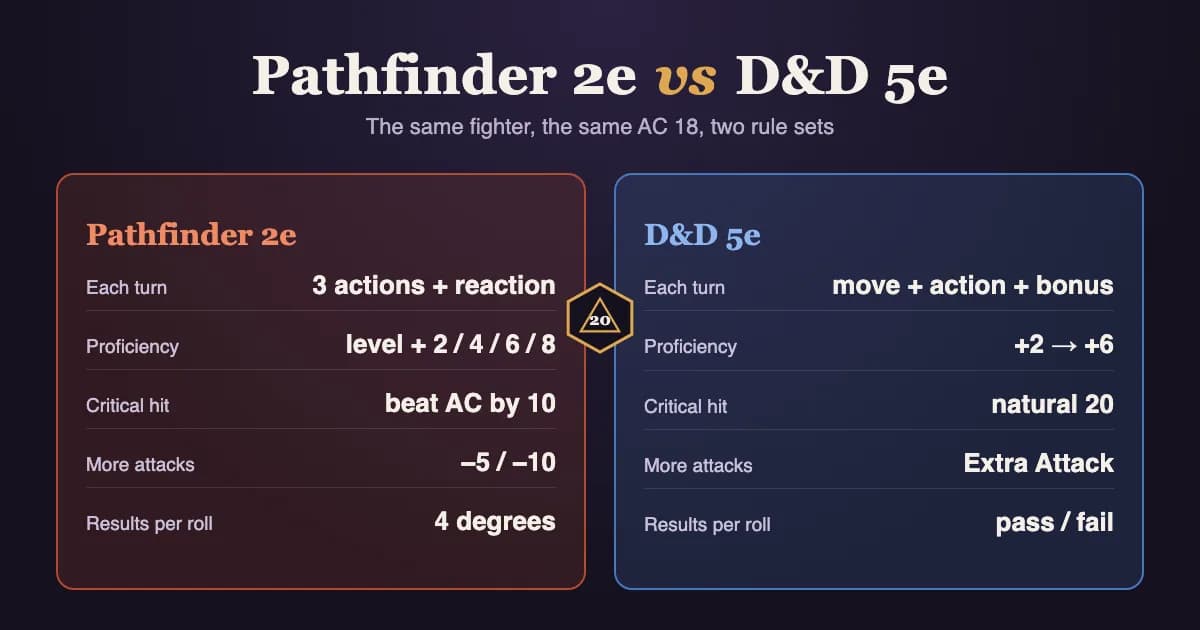
- Actions: Pathfinder 2e gives you three actions and a reaction, and almost everything costs one, two or three of them. D&D 5e gives you movement, an action, sometimes a Bonus Action, and a reaction.
- Proficiency: in Pathfinder your whole level is in every roll you are trained in, plus 2 to 8 for your rank. In D&D the proficiency bonus runs from +2 to +6 across twenty levels.
- Critical hits: in Pathfinder you crit by beating the AC by 10, and a natural 20 or 1 moves the result one step. In D&D only a natural 20 on an attack roll is a crit.
- Attacking twice: Pathfinder lets anyone attack three times a turn at −5 and −10. D&D has no penalty, but extra attacks come only from class features.
- Characters: Pathfinder hands out a feat or another choice at every level. D&D front-loads the choices into species, background, class and subclass.
| Topic | Pathfinder 2e | D&D 5e |
|---|---|---|
| Core roll | d20 + modifiers against a DC or AC | d20 + modifiers against a DC or AC |
| A turn | 3 actions and 1 reaction | Movement, 1 action, 1 Bonus Action if a feature grants one, 1 Reaction |
| Proficiency | Level + 2/4/6/8 by rank; untrained +0 | +2 at level 1 to +6 at level 17, the same for everything you are proficient in |
| Critical hit | Beat the AC by 10, or a natural 20 that hits; double damage | Natural 20 on the attack roll; damage dice rolled twice |
| Degrees of success | Four on every check | Pass or fail, unless a rule says otherwise |
| Attacking more than once | −5 / −10 per extra attack in a turn (agile −4 / −8) | No penalty; Extra Attack adds attacks at 5th, 11th and 20th level |
| Who your character is | Ancestry, heritage, background, class, then feats almost every level | Species, background, class, then a subclass and a few feats |
| Level-1 fighter HP (Con +2) | 20 (Human 8 + Fighter 10 + Con 2) | 12 (Fighter 10 + Con 2) |
| Open licence | ORC License (Player Core) | Creative Commons CC-BY-4.0 (SRD 5.2) |
Which rules this comparison uses
For Pathfinder, the remastered Player Core, the version of the second edition rules Paizo published under the open ORC License, read on Archives of Nethys, the official online rules reference, on . The Remaster renamed a few things: flat-footed is now Off-Guard, ability scores are attributes, and Attack of Opportunity is the fighter's Reactive Strike. This article uses the new names, as Nat20 does.
For D&D, the SRD 5.2, the 2024 revision of the fifth edition rules released under Creative Commons. Every number in the worked example (the proficiency bonus, Extra Attack, how a critical hit doubles the dice) is the same in the 2014 rules (SRD 5.1). Character building is where the two versions differ: the 2024 rules call your people a species and move the ability score increases to the background, where the 2014 rules called it a race and attached the increases to it. Nat20's 5E SRD entries follow the 2014 wording, so you will find the Fighter and the races there under those names.
The action economy
This is the difference players notice in the first five minutes. A Pathfinder turn is a budget of three actions. Moving (a Stride, up to your Speed) costs one. Attacking (a Strike) costs one. Raising a shield, drawing a weapon, stepping five feet, getting up from prone, most of them cost one. Most spells cost two, and some let you spend one, two or three for different effects. You can Strike three times, move three times, or move, Strike and raise your shield, and the choice is the game.
A D&D 5e turn has slots instead of a budget. You can move up to your Speed and take one action, in any order, and split your movement around the action. A Bonus Action exists only when a feature or a spell gives you one (two-weapon fighting, a cleric's Spiritual Weapon, a rogue's Cunning Action). The Attack action makes one attack, until a class feature such as Extra Attack adds more. Both games give you one reaction per round.
| Topic | Pathfinder 2e | D&D 5e |
|---|---|---|
| What you get each turn | 3 actions and 1 reaction, regained at the start of your turn | Movement up to your Speed, 1 action, 1 Bonus Action (only if a feature or spell gives you one) and 1 Reaction per round |
| Moving | Each Stride (up to your Speed) costs 1 action; moving twice costs 2 | Free up to your Speed, splittable around your action; Dash doubles it |
| Attacking | Each Strike costs 1 action; up to 3 a turn, with the multiple attack penalty | The Attack action: 1 attack, 2 with Extra Attack at 5th level (fighters get 3 at 11th and 4 at 20th) |
| Spells | Most cost 2 actions; some 1 or 3, and the number can change the effect | Usually the Magic action; some take a Bonus Action or a Reaction |
| Shields and other options | Raise a Shield costs 1 action: the shield’s bonus (+2 for a typical shield) applies until your next turn | A shield’s AC bonus is always on while you hold it |
| Reactions | One a round, e.g. a fighter’s Reactive Strike | One a round, e.g. an Opportunity Attack |
| Initiative | Usually a Perception check | A Dexterity check |
What it means at the table: Pathfinder turns ask a decision three times, so new players take longer, and experienced ones find more to do. D&D turns are shorter to explain ("move and take your action"), and the interesting choices sit in which action, not how many. Neither is faster in general: a Pathfinder fighter who Strikes three times resolves three attack rolls, and so does a level-11 D&D fighter taking the Attack action.
Proficiency: why level matters so much more in Pathfinder
In Pathfinder 2e every skill, save, weapon and spell has a proficiency rank. Untrained adds nothing. Trained, expert, master and legendary add your level plus 2, 4, 6 or 8. A level-1 fighter who is an expert with martial weapons adds 1 + 4 = +5; at level 20, legendary, the same fighter adds 20 + 8 = +28. The fighter is the class with the best weapon ranks: expert from level 1, master at level 5 with Fighter Weapon Mastery and legendary at level 13 with Weapon Legend, each for one weapon group.
In D&D 5e there is one number, the proficiency bonus, and it is the same for everything you are proficient in: +2 at level 1, +3 at level 5, +4 at level 10 and +6 at level 20. The design goal is called bounded accuracy: a goblin with AC 15 is still worth fighting at level 10, and a level-1 character can still hit a dragon on a good roll.
| Rank | Formula | Level 1 | Level 5 | Level 10 | Level 20 |
|---|---|---|---|---|---|
| Untrained | +0 | +0 | +0 | +0 | +0 |
| Trained | Level + 2 | +3 | +7 | +12 | +22 |
| Expert | Level + 4 | +5 | +9 | +14 | +24 |
| Master | Level + 6 | +7 | +11 | +16 | +26 |
| Legendary | Level + 8 | +9 | +13 | +18 | +28 |
| D&D 5e (proficient) | Proficiency Bonus | +2 | +3 | +4 | +6 |
| Character level | Proficiency Bonus |
|---|---|
| 1–4 | +2 |
| 5–8 | +3 |
| 9–12 | +4 |
| 13–16 | +5 |
| 17–20 | +6 |
The consequence for game masters is the biggest practical difference between the systems. In Pathfinder, a creature's level drives its AC, saves and attacks the same way, so a monster four levels below the party is a pushover and one four levels above can wipe it out. In D&D, the numbers move slowly, so a horde of weak monsters stays dangerous and a single strong one is beatable with luck. Pathfinder's Untrained rank also matters: an untrained character falls further behind every level, so a level-10 wizard climbing a wall is far worse at it than the level-10 rogue next to her.
Degrees of success and critical hits
Pathfinder 2e has four results on every check: critical success, success, failure and critical failure. You critically succeed when your total meets or beats the DC by 10 or more, and critically fail when you miss it by 10 or more. Then the die itself matters: a natural 20 makes the result one step better, a natural 1 one step worse. A Strike that critically succeeds deals double damage, modifiers included.
D&D 5e is pass or fail. On an attack roll, a natural 20 always hits and is a Critical Hit, which rolls the damage dice twice (the modifier is added once), and a natural 1 always misses. On ability checks and saving throws, a 20 or a 1 is just a number. Some spells and features have their own steps (half damage on a successful save, for instance), but there is no general rule for beating a DC by a lot.
| Pathfinder 2e | D&D 5e | |
|---|---|---|
| Critical success | Meet or beat the DC by 10 or more | No such result on most rolls; a natural 20 on an attack roll is a Critical Hit |
| Critical failure | Miss the DC by 10 or more | No such result on most rolls; a natural 1 on an attack roll misses |
| Natural 20 | One degree better than the numbers alone (a miss can become a hit, a hit a critical hit) | On an attack roll: hits whatever the AC, and is a Critical Hit. On a check or save: just a 20 |
| Natural 1 | One degree worse (a hit by 10 or more is still a hit) | On an attack roll: always misses. On a check or save: just a 1 |
| Critical hit damage | Double the whole damage roll, modifiers included | Roll the damage dice twice; modifiers are added once |
| Saving throws | Four outcomes, written into each spell (e.g. basic saves: none, half, full, double) | Pass or fail; many spells deal half damage on a success |
Here is what that looks like for one attack: the level-1 fighter's first attack against AC 18, every face of the d20. The Pathfinder fighter attacks at +9 (Strength +4, expert +5), the D&D fighter at +5 (Strength +3, proficiency +2).
| d20 | Pathfinder 2e | D&D 5e |
|---|---|---|
| 1 | Critical failure (miss) | Miss |
| 2–8 | Failure (miss) | Miss |
| 9–12 | Success (hit) | Miss |
| 13–18 | Success (hit) | Hit |
| 19 | Critical success (critical hit) | Hit |
| 20 | Critical success (critical hit) | Critical Hit |
Two things stand out. The Pathfinder fighter crits on a 19 as well as a 20, because 19 + 9 = 28 beats 18 by 10; at higher levels the crit range widens fast. And a natural 1 does not always miss in Pathfinder: when your bonus is so high that even a 1 would beat the AC by 10, the natural 1 only lowers a critical hit to a hit. In D&D the crit chance is 5% at every level for most characters (the SRD's Champion subclass widens it to 19–20 at level 3 and 18–20 at level 15).
The multiple attack penalty
Because a Strike costs only one action, anyone in Pathfinder can attack three times. The second attack of your turn takes a −5 penalty and the third and later attacks −10. Weapons with the agile trait, such as a shortsword, reduce that to −4 and −8. The penalty counts attacks on your own turn only, so a reaction like the fighter's Reactive Strike, made on an enemy's turn, is at full bonus.
| 1st attack | 2nd attack | 3rd and later | |
|---|---|---|---|
| Penalty | — | −5 | −10 |
| Penalty, agile weapon | — | −4 | −8 |
| Longsword (to hit) | +9 | +4 | −1 |
| Shortsword, agile (to hit) | +9 | +5 | +1 |
D&D 5e has no such penalty. Instead it limits the number of attacks: one per Attack action until Extra Attack, which the fighter gets at level 5 (two attacks), level 11 (three) and level 20 (four), every one at the full bonus. Pathfinder's third attack is rarely the best use of an action; the worked example below shows exactly how little it adds, which is why fighters often spend it raising a shield or moving instead.
Character building
A Pathfinder 2e character is four choices at level 1: an ancestry (such as Human, which gives 8 Hit Points and a Speed of 25 feet), a heritage within it, a background and a class, plus four free attribute boosts. After that, the class table hands out something at every level: class feats on even levels, skill feats on even levels, general feats at 3, 7, 11, 15 and 19, ancestry feats at 5, 9, 13 and 17, skill increases on odd levels from 3, and four more boosts every five levels. There are hundreds of options for each slot; Nat20's Pathfinder 2e catalog alone lists 6,044 feats.
A D&D 5e character is a species, a background and a class. In the 2024 rules the background carries the ability score increases (+2 and +1, or +1 to three abilities) and an Origin feat, the class gives the hit die, training and features, and a subclass arrives at level 3. Ability Score Improvements, which can be swapped for a feat, come at levels 4, 8, 12 and 16 (fighters also get 6 and 14), with an Epic Boon at 19. Fewer choices, each bigger.
| Topic | Pathfinder 2e | D&D 5e |
|---|---|---|
| Origin | Ancestry (Hit Points, size, Speed, attribute boosts and flaws, an ancestry feat) and a heritage within it | Species (size, Speed and special traits) |
| Upbringing | Background: two attribute boosts, a trained skill and a Lore skill, a skill feat | Background: +2/+1 or +1/+1/+1 to three listed abilities, an Origin feat, two skills and a tool |
| Class | Key attribute boost, Hit Points per level, starting proficiency ranks and class features | Hit die, saving throws, weapon and armour training, class features; a subclass at 3rd level |
| Attributes | Four free boosts at 1st level, four more at 5th, 10th, 15th and 20th; above +4 a boost counts half | Ability Score Improvements at 4th, 8th, 12th and 16th (the fighter also at 6th and 14th); an Epic Boon at 19th |
| Feats | Ancestry, class, skill and general feats on a fixed schedule: something new at every level | An Origin feat, then a feat in place of an Ability Score Improvement |
| Skills | Each skill climbs its own rank, from trained to legendary | Proficient or not (Expertise doubles the bonus for some classes) |
| Level | Pathfinder 2e fighter | D&D 5e fighter |
|---|---|---|
| 1 | Ancestry feat, fighter feat, Reactive Strike, Shield Block, expert in simple and martial weapons | Fighting Style, Second Wind, Weapon Mastery, an Origin feat from the background |
| 2 | Fighter feat, skill feat | Action Surge, Tactical Mind |
| 3 | General feat, skill increase, Bravery | Subclass (the SRD’s Champion) |
| 4 | Fighter feat, skill feat | Ability Score Improvement or a feat |
| 5 | Ancestry feat, skill increase, four attribute boosts, Fighter Weapon Mastery (master in one weapon group) | Extra Attack, Tactical Shift |
One number shows how the two systems treat a starting character. A human Pathfinder fighter with Constitution +2 starts with 8 + 10 + 2 = 20 Hit Points and has 68 at level 5 (ancestry HP once, then 10 + 2 per level). A D&D fighter with the same Constitution starts with 10 + 2 = 12 and has 44 at level 5 with fixed hit points (6 + 2 per level after the first). Pathfinder's level-1 characters are sturdier, and its level-1 monsters hit harder to match.
Worked example: the same fighter, two systems
The assumptions, kept as close as the two rule sets allow:
- Weapon: a longsword in both games, 1d8 damage plus Strength. No magic weapon, no property runes, no other item bonus.
- Pathfinder fighter: Strength +4 at level 1 (the most a level-1 character can have), still +4 at level 5 (a boost above +4 only counts half until the next one), +5 at level 10 and +6 at level 20. Expert with the longsword at level 1, master at level 5, legendary from level 13.
- D&D fighter: Strength 17 (+3) at level 1, from a 15 and the background's +2; 18 (+4) at level 4 and 20 (+5) at level 6 with Ability Score Improvements. A Fighting Style that does not change attack or damage numbers, and no subclass features.
- Target: AC 18. One turn: the Pathfinder fighter Strikes three times, the D&D fighter takes the Attack action (no Action Surge).
- Expected damage: the average damage of a hit times the chance of a hit, plus the same for a critical hit, added over the turn. Exact fractions, no rounding.
A hit with the longsword averages 8.5 damage for the Pathfinder fighter (4.5 for the d8 plus 4) and a critical hit 17, double the lot. The D&D fighter's hit averages 7.5 and a Critical Hit 12: the d8 is rolled twice, the +3 added once.
| Attack | To hit | Hits (any) | Critical hits | Expected damage |
|---|---|---|---|---|
| Pathfinder: Strike 1 | +9 | 60% | 10% | 5.95 |
| Pathfinder: Strike 2 | +4 | 35% | 5% | 3.4 |
| Pathfinder: Strike 3 | −1 | 10% | 5% | 1.275 |
| Pathfinder: the turn | 10.625 | |||
| D&D: attack 1 | +5 | 40% | 5% | 3.225 |
| D&D: the turn | 3.225 | |||
At level 1 the Pathfinder fighter's first Strike hits 60% of the time and crits 10%, for 5.95 damage on average. The second Strike, at +4, adds 3.4; the third, at −1, hits only on a 19 or a 20 and adds 1.275. The whole turn is worth 10.625 damage. The D&D fighter's single attack hits 40% of the time, crits 5%, and is worth 3.225.
| Attack | To hit | Hits (any) | Critical hits | Expected damage |
|---|---|---|---|---|
| Pathfinder: Strike 1 | +15 | 90% | 40% | 11.05 |
| Pathfinder: Strike 2 | +10 | 65% | 15% | 6.8 |
| Pathfinder: Strike 3 | +5 | 40% | 5% | 3.825 |
| Pathfinder: the turn | 21.675 | |||
| D&D: attack 1 | +7 | 50% | 5% | 4.475 |
| D&D: attack 2 | +7 | 50% | 5% | 4.475 |
| D&D: the turn | 8.95 | |||
At level 5 the Pathfinder fighter is a master with the longsword and attacks at +15, +10 and +5. Against AC 18 the first Strike now crits 40% of the time, and the turn is worth 21.675. The D&D fighter has Extra Attack: two attacks at +7, each hitting 50% of the time, for 8.95 a turn.
| Turn | Attacks | Expected damage | Hits, all attacks |
|---|---|---|---|
| Pathfinder, level 1, longsword | 3 Strikes | 10.625 | 60% / 35% / 10% |
| Pathfinder, level 1, agile shortsword | 3 Strikes | 10.5 | 60% / 40% / 20% |
| Pathfinder, level 1, longsword, target Off-Guard (AC 16) | 3 Strikes | 14.025 | 70% / 45% / 20% |
| D&D, level 1, longsword | 1 attack | 3.225 | 40% |
| Pathfinder, level 5, longsword | 3 Strikes | 21.675 | 90% / 65% / 40% |
| D&D, level 5, longsword | 2 attacks | 8.95 | 50% / 50% |
Two variations are in the summary. With an agile shortsword (1d6, penalties of −4 and −8) the level-1 Pathfinder turn is worth 10.5, almost exactly the longsword's 10.625: the smaller die is paid back by the smaller penalty on the second and third Strikes. And against an Off-Guard target, whose AC drops by 2 (a flanked enemy, for example), the same longsword turn rises to 14.025. A −2 to AC is worth a lot in Pathfinder because it moves the crit threshold as well as the hit threshold.
How proficiency scaling changes the to-hit
| Level | Pathfinder bonus | Pathfinder hits / crits | D&D bonus | D&D hits / crits | D&D attacks |
|---|---|---|---|---|---|
| 1 | +9 (expert) | 60% / 10% | +5 | 40% / 5% | 1 |
| 5 | +15 (master) | 90% / 40% | +7 | 50% / 5% | 2 |
| 10 | +21 (master) | 95% / 70% | +9 | 60% / 5% | 2 |
| 20 | +34 (legendary) | 100% / 95% | +11 | 70% / 5% | 4 |
From level 1 to level 20 the Pathfinder fighter's attack bonus goes from +9 to +34; the D&D fighter's goes from +5 to +11. Against the same AC 18, the level-20 Pathfinder fighter cannot miss: even a natural 1 totals 35, a critical hit lowered to a hit. The D&D fighter hits 40% of the time at level 1 and 70% at level 20, and makes 4 attacks instead of one.
What these numbers do not say. They do not say the Pathfinder fighter is twice as strong. AC 18 means different things in the two games. In D&D it is a well-armoured target at any level, which is the point of bounded accuracy. In Pathfinder, a creature's AC rises with its level, so a level-5 fighter normally faces something much harder to hit than AC 18, and the hit and crit chances land back near the level-1 figures. What the table does show is how much of a Pathfinder roll is the level: a fight between creatures of different levels is lopsided by design, and that is the lever Pathfinder game masters use to set difficulty.
Which should your table pick?
Neither system is better. They are built for different tables:
- Pick Pathfinder 2e if your group enjoys tactical combat, where flanking, raising a shield or a third Strike are real decisions; if your players like building characters and want a new choice every level; and if the game master wants the encounter math to be predictable, because level differences mean the same thing in every fight.
- Pick D&D 5e if your players are new to tabletop games or already know it; if you want quicker rules lookups and fewer modifiers to track; and if you like a wide range of monsters staying relevant across levels, so a story about goblins can last a whole campaign.
- Either works for theatre-of-the-mind play, for a campaign that is mostly exploration and talking, and on a budget: both have their core rules free to read under open licences (the SRD 5.2 and the Pathfinder rules on Archives of Nethys).
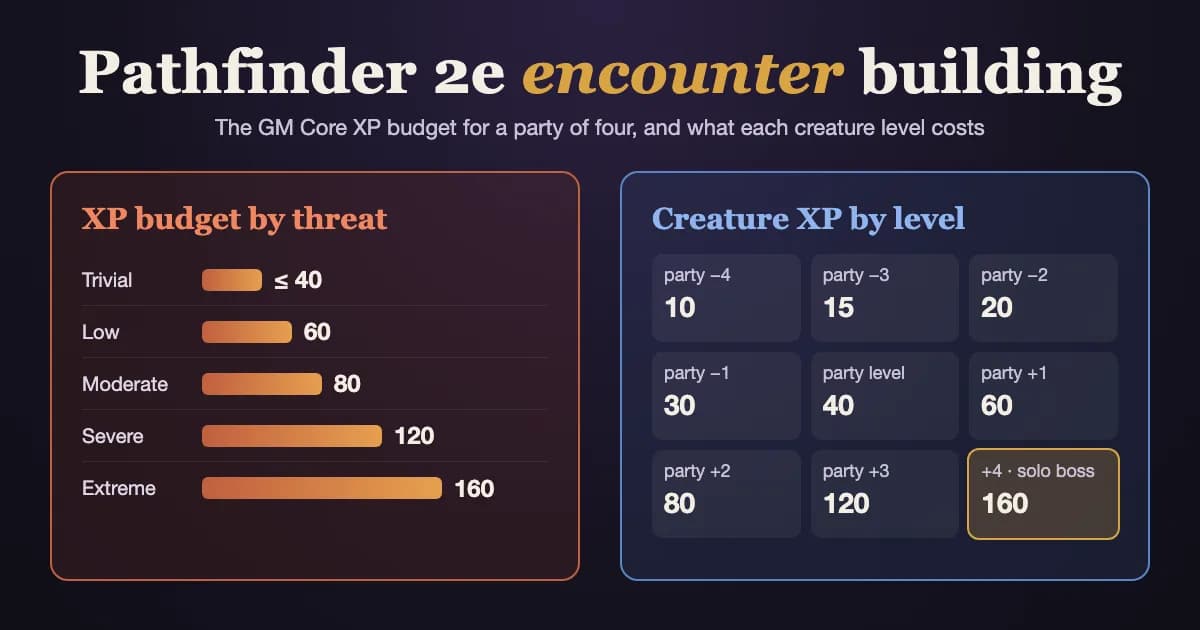
If you are moving a 5e group to Pathfinder, the habits to change are the ones in this article: count to three actions, apply the multiple attack penalty, check every roll for a critical success or failure, and respect level differences when building fights. Pathfinder 2e encounter building works that last point out with Pathfinder's XP budget, and our guide to balancing D&D encounters shows the 5e side of it, with the SRD 5.2 XP budget.
How to run either on Nat20
Nat20 is a free tabletop in the browser, and both rulesets are live there, in English and Spanish: the Pathfinder 2e ruleset, with 9,470 entries (classes, ancestries, heritages, backgrounds, class features, feats, spells and conditions), and the 5E SRD, with its 12 classes, 428 monsters, spells, conditions and rules. Every entry linked in this article, from the Pathfinder Fighter to the 5e fighter's Extra Attack, is a page you can open without an account.
What you get for a session, in either system:
- The rules at the table. Start a session and pick its ruleset. During play you search that ruleset and share an entry as a card with all your players or a few of them: Off-Guard's −2 to AC, a spell's range, the fighter's Reactive Strike.
- Characters. A Pathfinder character in Nat20 has an ancestry, a class and a background linked to their entries, a level from 1 to 20, six scores whose modifiers are calculated for you, and the Hit Points, AC and Speed you enter. Nat20 does not add proficiency or level to anything: you work out the +9 yourself, as on a paper sheet.
- Combat. The tracker orders combatants by initiative, counts rounds, holds HP and adds status effects with a name and a duration that counts down once per round. Players see the order, the round and whose turn it is; they do not see status effects on the shared combat card, so announce Off-Guard or Frightened out loud or share the condition's card.
- Dice and checks. Everyone rolls in a shared dice tray, attack bonus included. A check you request from a player reports pass or fail against a DC only you see; it does not report Pathfinder's four degrees, so compare the total with the DC yourself when a critical success matters.
- A map. A shared grid with tokens, 5 feet a square by default, which suits both games. There is no dynamic lighting and no fog of war.
What Nat20 does not do: it does not count actions or apply the multiple attack penalty, and it does not roll attacks or saves for you. The Pathfinder 2e ruleset has no creatures, no equipment and no ready-made characters yet, so monster stat blocks come from your books and characters are built by your players. The 5E SRD side has monsters, which makes it the quicker one to prepare a fight with. Every player needs a free account to join a session; the free initiative tracker works without one for an in-person game.
The Pathfinder 2e virtual tabletop guide walks through a full Pathfinder encounter in Nat20 step by step, from creating the session to the last condition, and the Pathfinder 2e launch post lists what the ruleset includes.
Where to go next
For the 5e side of combat: how to track initiative in D&D, the D&D 5e conditions cheat sheet (the closest thing 5e has to Off-Guard is the Advantage that conditions such as Prone or Restrained give attackers) and how to balance D&D encounters. For the Pathfinder side, start at the Pathfinder 2e virtual tabletop hub, then open the Pathfinder Fighter and the 5e Fighter side by side.
Licence
This work includes material taken from the System Reference Document 5.2 ("SRD 5.2") by Wizards of the Coast LLC, available at https://www.dndbeyond.com/srd. The SRD 5.2 is licensed under the Creative Commons Attribution 4.0 International License, available at https://creativecommons.org/licenses/by/4.0/.
This work includes material from Pathfinder Player Core, licensed under the ORC License, located at the Library of Congress at TX 9-307-067 and available online at https://paizo.com/orclicense and other locations. All warranties are disclaimed as set forth therein. Attribution:
Pathfinder Player Core © 2023 Paizo Inc., Designed by Logan Bonner, Jason Bulmahn, Stephen Radney-MacFarland, and Mark Seifter. Authors: Alexander Augunas, Kate Baker, Logan Bonner, Jason Bulmahn, Carlos Cabrera, Calder CaDavid, James Case, Eleanor Ferron, Steven Hammond, Joan Hong, Vanessa Hoskins, James Jacobs, Jenny Jarzabski, Erik Keith, Dustin Knight, Lyz Liddell, Luis Loza, Patchen Mortimer, Dennis Muldoon, Stephen Radney-MacFarland, Mikhail Rekun, David N. Ross, Michael Sayre, Mark Seifter, Kendra Leigh Speedling, Mark Thompson, Clark Valentine, Andrew White, Landon Winkler, and Linda Zayas-Palmer
Pathfinder is a trademark of Paizo Inc. Dungeons & Dragons is a trademark of Wizards of the Coast LLC. Nat20 is not affiliated with either company.