Homebrew vs Official Rulesets: When to Bend the Rules in Your TTRPG
House rules are a joy — and a trap. When to homebrew, when to leave the rules alone, and how to do it without waking up inside a rules argument.
Every table eventually faces the question: do we play the rules as written, or do we start bending them? Homebrew — house rules and custom content — is one of the great joys of tabletop gaming, but it's also where campaigns pick up the subtle imbalances and forgotten exceptions that cause arguments months later. Here's how to think about when to bend the rules, and how to do it without breaking your game.
What official rulesets buy you
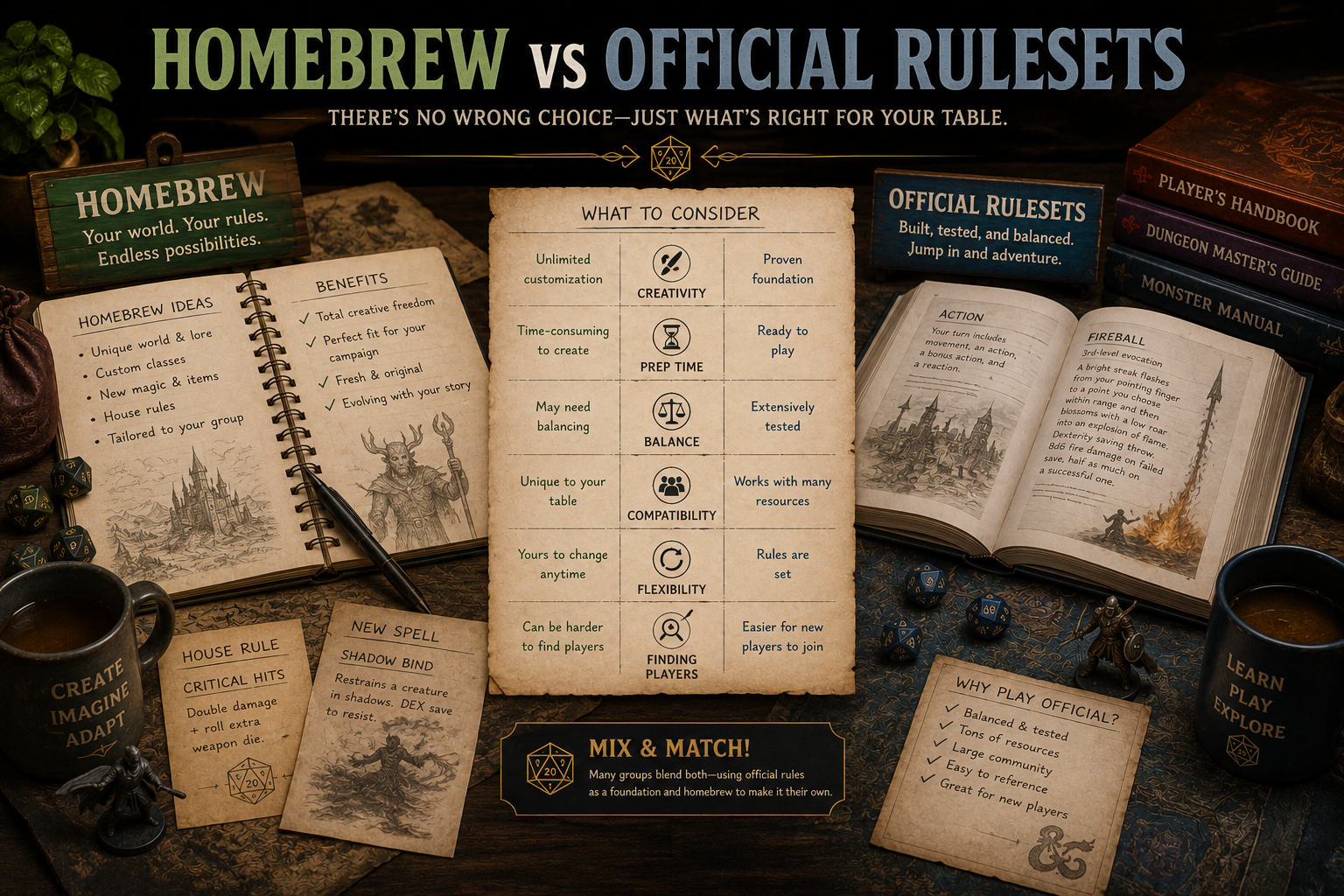
The core rules are tested, balanced, and shared. When you play rules-as-written, every player already knows how things work, the math has been stress-tested by millions of sessions, and a new player can join without relearning your table's idiosyncrasies. That shared baseline is genuinely valuable — don't discard it lightly.
What homebrew buys you
Official rules are written for the average table, and yours is not average. Homebrew lets you tune the game to your group: faster combat, grittier survival, a custom class that fits your setting, or a magic item that rewards the story you're telling. Done well, it makes the game feel like yours.
When to bend the rules
Good candidates for a house rule usually share one of these signs:
- A rule slows the table down every single session (looking at you, encumbrance).
- A rule contradicts the tone you agreed on in your session zero.
- Your setting needs something the core rules don't cover — new ancestries, factions, or gear.
- A player has a concept the official options can't quite express.
When to leave the rules alone
Resist homebrew when:
- You haven't played the rule as written enough to know it's actually a problem.
- The change mainly benefits one player at the expense of table balance.
- You're patching a single bad session rather than a recurring issue.
The golden rule: change rules to solve real, repeated problems — not hypothetical ones.
How to homebrew without chaos
The danger of house rules isn't the rules themselves — it's that they live in your head and nowhere else. Six weeks later, half the table remembers the change differently and the other half never heard it. Two habits fix this:
- Write it down in one place. Every house rule and every piece of custom content should live in a single reference the whole table can read.
- Change one thing at a time. Introduce a rule, play with it for a few sessions, then decide to keep or cut it. Stacking ten untested changes at once makes it impossible to tell which one broke the math.
Build your ruleset in the open
This is exactly what rulesets on Nat20 are for. You can start from the official 5E SRD and fork it into a homebrew ruleset — adding custom monsters, items, spells, and rules as entities your players can browse and your campaignscan link to directly. Because it's shared, there's one canonical answer to "how does our version work?" — and because it's versioned, you can evolve it without losing track of what changed.
Homebrew and official rules aren't enemies. The strongest campaigns start from a solid official base and bend it deliberately, one tested change at a time, all recorded where the whole table can see. That's how you get a game that's uniquely yours without waking up one day inside a rules argument nobody can resolve.