How to Prep a D&D One-Shot (+5 Ideas to Steal)
A one-shot must hook the table in five minutes and end in four hours. How long to plan, a five-scene structure, a prep checklist, and five ideas.
A one-shot is not a short campaign. A campaign can leave threads hanging for months; a one-shot has to hook the table in the first five minutes and land a real ending before people start checking the time. That changes how you prep. You are not building a world, you are building an evening — and the whole thing can be ready in a couple of hours if you prep the right things and skip the rest.
How long should a one-shot be?
Plan for three to four hours of play, and budget it before you write anything. A reliable split for a four-hour slot:
- 15 minutes — introductions, characters, and the opening scene.
- 2 hours — two or three middle scenes, about 45 minutes each.
- 1 hour — the climax.
- 15–30 minutes — buffer, epilogue, and the inevitable snack break.
The budget tells you how much content to write. If a combat takes 45 minutes at your table, a four-hour one-shot has room for two fights, not five. Most one-shots that run long do so because they were prepped like a dungeon crawl and played like a story.
Step 1: Write the premise in one sentence
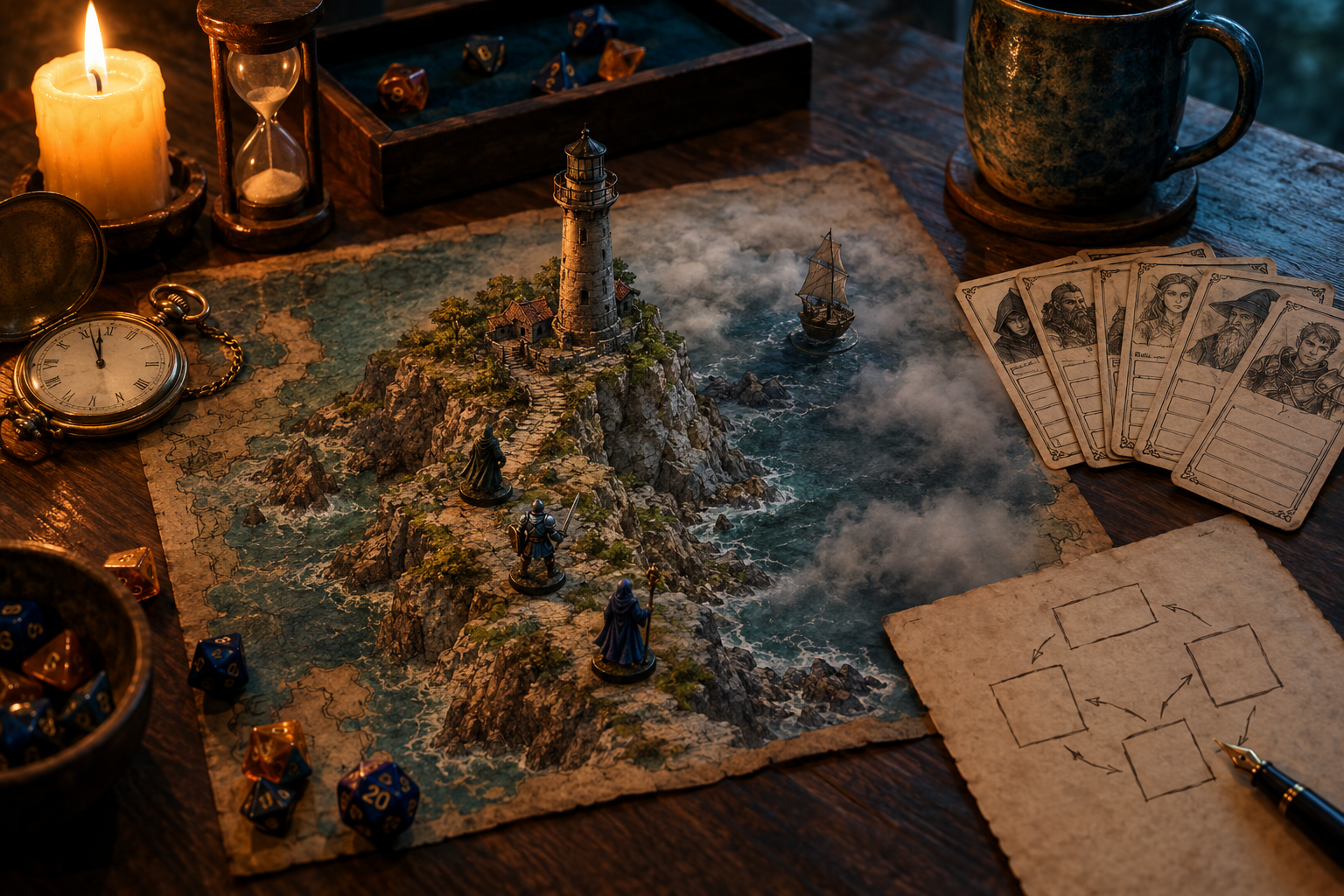
Everything hangs off one line with three parts: someone wants something, something is in the way, and it has to happen tonight. "The lighthouse keeper has vanished, a ship is due at midnight, and the lamp is dark." That last clause matters most. A deadline in the fiction is what keeps a one-shot moving — players stop wandering when the clock is visible to their characters too.
Step 2: Use a five-scene structure
You do not need a plot, you need a shape. The classic five-room-dungeon pattern works for almost any one-shot, whether the "rooms" are caves, a manor house, or a city at night:
- The hook, already in motion. Start at the door of the problem, not in a tavern. The first scene should end with the characters committed.
- A test that is not a fight. A guard to talk past, a puzzle, a locked gate — some way for non-combat characters to shine early.
- A setback or a twist. The ally is lying, the map is wrong, the thing they came to stop has already started. This is what makes it feel like a story rather than a checklist.
- The climax.The big fight or the big decision, ideally with an objective other than "reduce everything to zero HP" — close the portal, save the hostage, reach the lamp before midnight.
- The payoff. Two minutes of epilogue. Tell the players what their choices changed. It is the part they will remember on the drive home.
Step 3: Hand out pre-generated characters
Character creation can eat the first hour of a one-shot by itself. Pre-generated characters remove that, and they let you build the party for the adventure: if your climax is a negotiation, make sure someone is good at talking. Give each pre-gen one personal hook tied to the premise — "the missing keeper is your aunt" — and the opening scene does half its own work. For tables of new players, pre-gens are not optional: start at level 1 to 3, where each character has only a handful of options to learn.
Step 4: Prep scenes, not a script
For each scene, write three short notes and nothing more: what is here, what the players can learn, and what pushes them forward if they stall. That last note is your safety valve — a messenger arrives, the tide comes in, the floor gives way. If the one-shot depends on a piece of information, give it at least three ways to be found. One clue is a bottleneck; three clues is a mystery that cannot get stuck.
Step 5: Build the fights before the night
Encounters are where a one-shot loses the most time, so they get the most concrete prep. Choose the monsters, write down their hit points, and have every stat block open before anyone sits down. Make at least one fight about something other than damage: terrain that changes, a timer, an enemy who surrenders or flees. Then run the combat lean — the nine fixes for slow combat matter twice as much when you only have one evening.
Step 6: Decide in advance what you will cut
Every one-shot runs behind schedule at some point. Mark one scene as optional before you start, so when you are 30 minutes late you skip it without improvising under pressure. The fiction can help: the deadline you set in step 1 lets you say "you hear the ship's bell — it's nearly midnight" and move everyone straight to the climax.
Five one-shot ideas to steal
Each of these already has the premise, the deadline, and a twist waiting to happen. Change the names and run them.
- The Dark Lighthouse (levels 1–2).The keeper is gone, the lamp is dark, and a ship carrying the town's winter grain is due at midnight. Something in the cellar is drinking the light.
- The Last Ferry (level 1). The party escorts six villagers across a river at night while something follows the boat through the fog. Failure costs a villager, not the party — a gentle stakes curve for first-time players.
- The Goblin Wedding (levels 1–3). Two goblin clans have asked the party to officiate the wedding that ends their feud, and someone has poisoned the cake. Mostly roleplay, one fight, plenty of laughs.
- The Midnight Auction (levels 2–3).A cursed relic goes under the hammer at midnight in a noble's manor. Steal it, swap it, or outbid the cult that wants it — a heist with three valid approaches.
- The Tide Shrine (levels 1–3). Once a year the tide uncovers a sunken shrine for exactly three hours. Tell the players the real-world clock is the in-game clock, and watch how fast decisions get made.
The one-evening prep checklist
- One-sentence premise with a deadline
- An opening line to read aloud that starts the action
- Four or five pre-generated characters, each with a hook
- Five scenes, each with what is here, what they learn, and what pushes them on
- Every essential clue findable three ways
- Two encounters with monsters chosen and hit points written down
- A rough map or sketch for the climax
- Three spare NPC names for the moments you did not plan
- One scene marked as cuttable
- An ending for success and one for failure
Common one-shot mistakes
- Starting in a tavern. Twenty minutes of characters introducing themselves to a barkeep is twenty minutes of your climax gone.
- Too many fights. Three fights in four hours is the ceiling for most tables, and two is usually better.
- A mystery with a single clue. If the players miss it, the evening stops.
- No planned ending."We'll pick it up next time" is not an option when there is no next time.
Running it from one screen
A one-shot is short enough that the tools should disappear. Nat20's free dungeon master tools put the combat tracker, dice roller, battle map, session notes, and the stat blocks from the 5E SRD ruleset in one tab, so you are not flipping between a book, a phone, and a notebook mid-scene. Load your two encounters into the initiative tracker before the night, and the fights start the moment the dice come out. If you are running for strangers, spend five minutes on the essentials from the session zero checklist — tone and safety tools especially — before the hook drops.