Session Zero Checklist: Everything to Cover Before Your First Session
The one-hour meeting that saves your campaign. Tone, safety tools, schedule, house rules, and character creation — everything to align on before the dice come out.
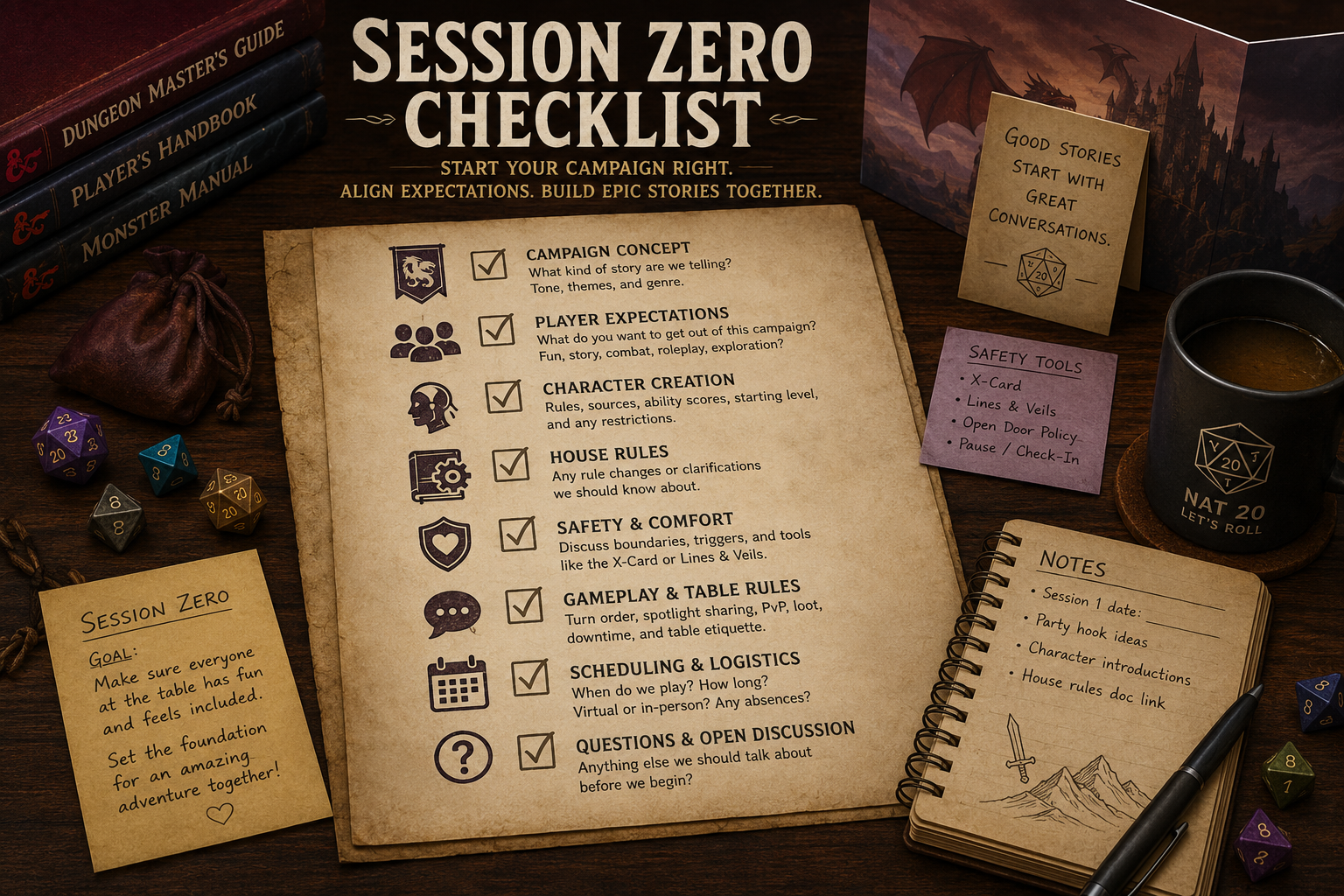
Session zero is the meeting you have before the campaign begins — no combat, no dice, just the group deciding together what the next few months of gaming will look like. Skipping it is the most common reason campaigns collapse: mismatched expectations, an uncomfortable table, or a schedule nobody actually committed to. Spend one hour here and you save yourself a dozen awkward conversations later. Here is everything worth covering.
1. Tone and content
Agree on the flavor of the game before anyone rolls a character. Is this grim and gritty, or heroic and hopeful? High fantasy or low magic? Comedy welcome, or strictly serious? A table expecting a political intrigue campaign will chafe against a dungeon crawl, and vice versa. Name the genre out loud so everyone builds toward the same story.
2. Safety tools and boundaries
Decide how the table handles content that makes someone uncomfortable. Lines (topics that never appear) and veils (topics that happen off-screen) are the classic tools, along with an X-card anyone can tap to pause a scene. This isn't about censoring the story — it's about making sure everyone can relax and play freely, which is when the best roleplay happens.
3. Schedule and commitment
More campaigns die to calendars than to dragons. Settle the practical questions now:
- How often do you play — weekly, biweekly, monthly?
- How long is a session, and who hosts (or which virtual table)?
- What's the quorum? Do you play with four of six players, or cancel?
- How much notice is expected for missing a session?
4. The rules you'll actually use
Every table houserules. Decide up front which optional rules are in play — flanking, critical-hit tables, encumbrance, multiclassing, feats — and whether you're running rules-as-written or a homebrew variant. Writing this down prevents the mid-combat rules argument that kills momentum. If you keep your ruleset in one shared place, players can check it themselves instead of asking you every session.
5. Character creation, together
Make characters as a group, not alone at home. Session-zero character creation lets the party build connections ("we're siblings," "I owe her a debt"), avoid four lone-wolf loners who have no reason to travel together, and cover the party's needs. Ask each player for a one-line motivation and one bond to another character — those two sentences will fuel more roleplay than a ten-page backstory.
6. Session-zero questions worth asking
- What do you want your character to be great at?
- What's a scene you're hoping we get to play?
- How does your character feel about violence? Authority? Money?
- What's one thing you'd rather this campaign avoid entirely?
Write it all down
The output of session zero shouldn't live in six different memories. Capture the agreements — tone, safety tools, schedule, house rules, and everyone's character hooks — somewhere the whole group can revisit. In Nat20 you can pin this to the top of your campaignas the first episode, so months later, when someone asks "wait, did we allow multiclassing?", the answer is one click away.
Do this once and your campaign starts on solid ground: everyone knows the tone, the boundaries, the cadence, and why their characters are in the same tavern. That's a foundation worth an hour of anyone's time.